Overmolding: From Injection Molding to Load-Path Hybrid Components
Plastic parts without continuous fiber hit stiffness and strength limits – overmolding with UD tapes pushes those limits significantly further

Injection molding enables the economical production of complex parts with short cycle times and a high degree of functional integration. Features such as ribs, fastening points, guides, or snap fits can be molded directly into the part.
In terms of stiffness and strength, however, plastic parts without continuous fiber reinforcement hit clear limits. Whether unreinforced or short-fiber-reinforced: once high forces must be transmitted, low deformation maintained, or sustained high mechanical loads carried, the performance of the molding material alone is often no longer enough. Increasing wall thickness or switching to metal is then the usual way out – with drawbacks in weight, cost, and functional integration.
This is exactly where overmolding with UD tapes comes in: by placing continuous fibers specifically along the load paths, the mechanical limit of injection-molded parts can be shifted significantly – without giving up the advantages of injection molding.
Short fibers increase the performance of the plastic
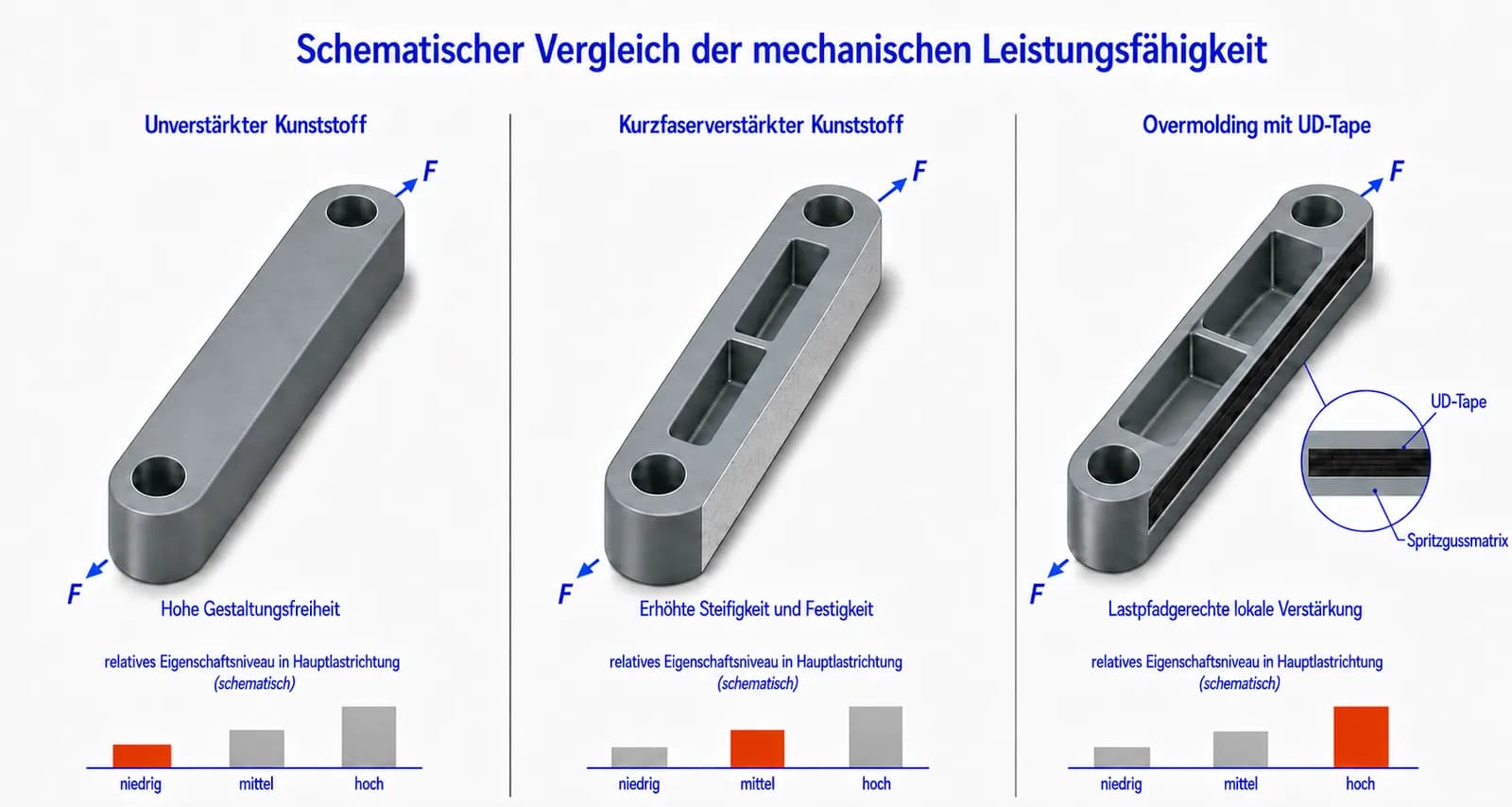
Adding short fibers – typically glass or carbon fibers – can significantly improve the stiffness, strength, dimensional stability, and creep resistance of an injection-molded part. The fibers are processed together with the polymer and align during molding along local flow directions.
This yields high-performance materials that can still be processed with established injection molding methods. Limited fiber length and process-driven fiber orientation nevertheless impose an upper bound on stiffness and strength. Especially under high or clearly directed loads, short fibers are not enough to reach the potential of continuous fiber reinforcement – the mechanical limit of the part remains.
UD tapes reinforce the part specifically in the load direction
To push beyond this limit, continuous fibers are required. In a UD tape, glass or carbon fibers lie parallel within a polymer matrix. “UD” stands for unidirectional. In the fiber direction, they can transmit substantially higher forces than unreinforced or short-fiber-reinforced plastics. Thermoplastic tapes can be heated, welded to one another, formed, and overmolded. You can find more on this in our blog post Continuous Fiber-Reinforced Thermoplastics (UD-Tapes).
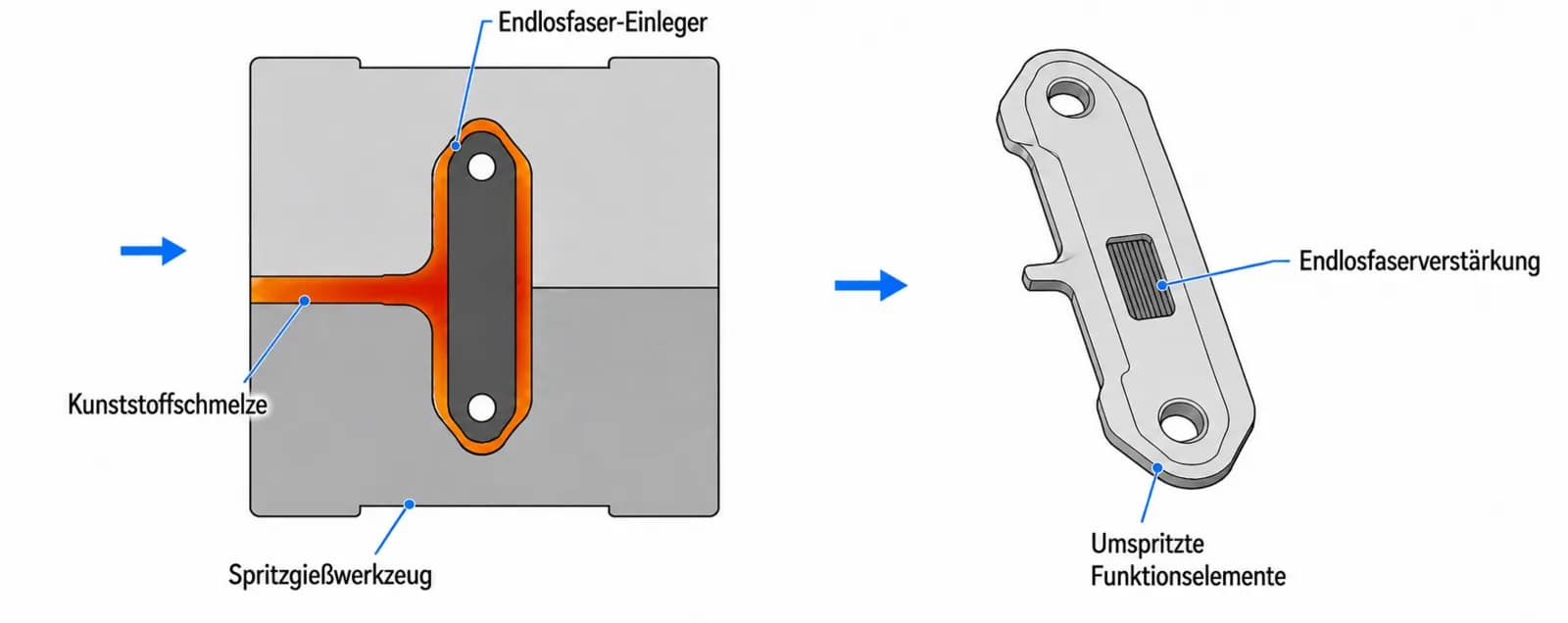
In overmolding, cut-to-size and optionally preformed UD tapes are placed in the injection mold and then overmolded with thermoplastic. The result is a hybrid part that combines the advantages of both technologies and specifically extends the mechanical performance of injection molding:
- Injection molding creates the complex geometry and integrates additional functions.
- Short fibers improve the mechanical properties of the entire molded body.
- UD tapes specifically reinforce the areas where particularly high loads occur.
Reinforcement can therefore be positioned and oriented exactly where it is structurally needed – for example along a load path, around a hole, at a load introduction point, or in a highly bending-loaded region.
Use material only where it is needed
The decisive advantage of overmolding with UD tapes is not blanket reinforcement of the entire part, but the load-path-appropriate combination of different material forms. Instead of increasing wall thickness or making the entire part from a more expensive material, continuous fibers are placed specifically in highly loaded regions. What matters is not only placing them in the right areas, but also orienting them correctly. Because fiber properties are best exploited under tensile loading, the fibers must be aligned along the load path.
In this way, plastic parts can be created whose stiffness and strength clearly exceed what is possible without continuous fiber reinforcement – while also reducing weight. Design freedom, functional integration, and the series capability of injection molding are retained.
Why use overmolding with UD tapes?
Overmolding combines the design freedom and cost-efficiency of injection molding with the mechanical performance of continuous-fiber-reinforced thermoplastics. It shifts the limit at which plastic parts fail in stiffness and strength – precisely where unreinforced or short-fiber-reinforced materials are no longer sufficient.
The goal is not to reinforce the entire part as strongly as possible. UD tapes are used specifically where high or clearly directed loads occur and the mechanical performance of the molding material would otherwise become the limiting factor.
Advantages of overmolding
High strength and stiffness along load paths
The continuous fibers of a UD tape can transmit substantially higher loads in the fiber direction than an unreinforced or short-fiber-reinforced injection molding material. When tapes are positioned along the actual load paths, part strength and stiffness can be increased in a targeted way.
Reinforcement is particularly useful, for example:
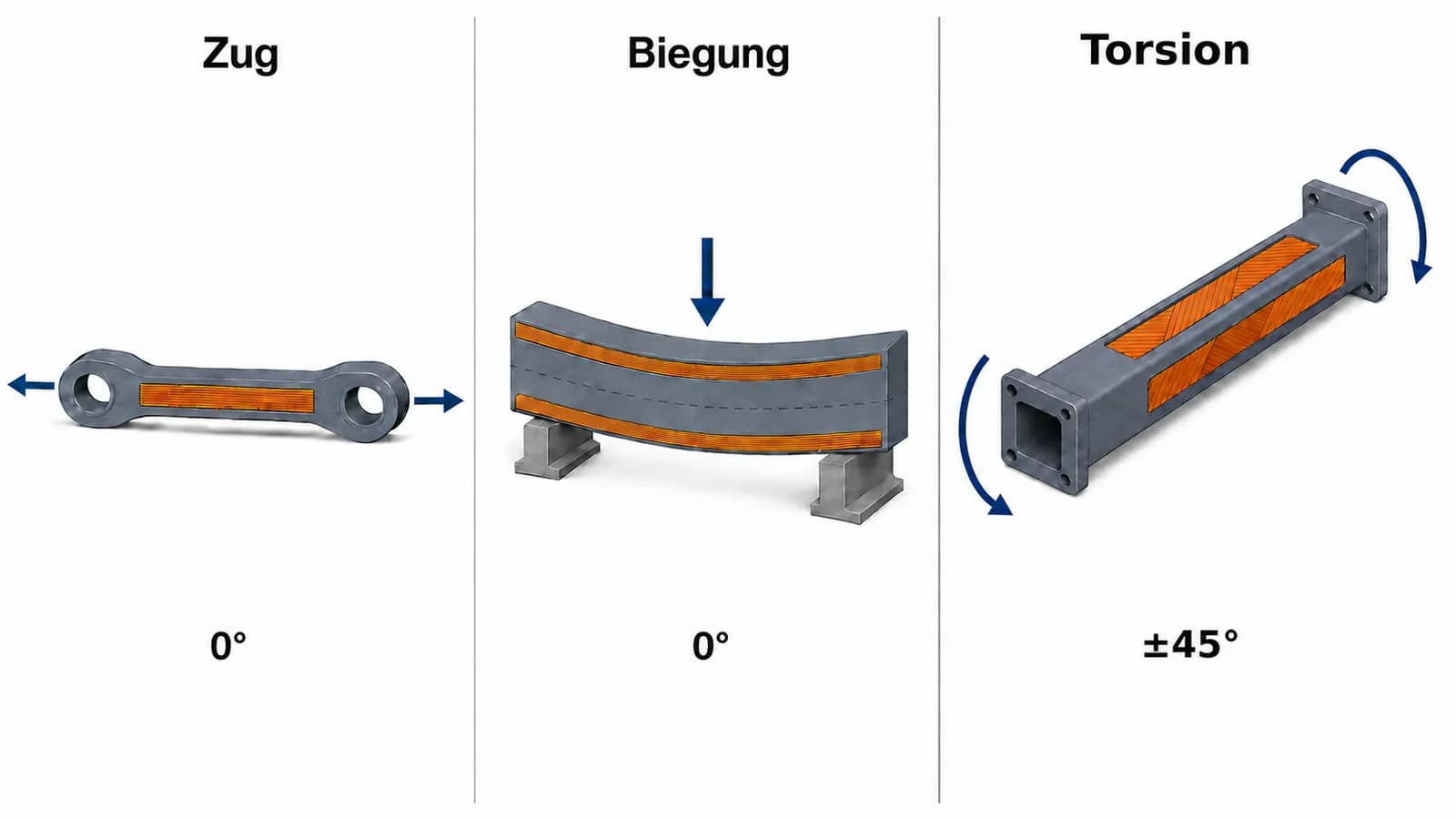
- between two load introduction points
- in bending-loaded regions of a part
- along tension and compression paths
- around holes and fastening points
- in areas with high local stresses
Because UD tapes have strongly anisotropic properties, their position and fiber direction must be adapted to the respective load case.
Weight and material savings
Due to the high load-bearing capacity of continuous fibers, wall thicknesses can be reduced or additional ribs and material accumulations avoided. Part weight and material usage can thus be lowered without falling short of the required mechanical performance.
Savings do not arise automatically from inserting a tape, however. The part must be redesigned to take advantage of the reinforcement. The potential is especially large when a previous metal part or a heavily dimensioned injection-molded part is deliberately re-engineered.
Reinforcement only where it is needed
Unlike a full-coverage composite structure, the higher-value continuous-fiber material is used only locally. Less loaded regions can still be made from a cost-effective unreinforced or short-fiber-reinforced injection molding material.
This creates a material-efficient hybrid build-up: the molding material forms the complex geometry, while the UD tape carries the high directed loads.
High functional integration
Overmolding the tapes retains the typical advantages of injection molding. Ribs, snap fits, guides, bearing seats, threaded inserts, and fastening elements can be integrated directly into the part.
The UD tape provides structural reinforcement, while the molding material creates the three-dimensional geometry, introduces loads into the reinforcement, and supplies additional functions. Multi-part assemblies can often be simplified and downstream assembly steps reduced.
Series-capable process
After the tape is inserted, part production largely follows a conventional injection molding cycle. Depending on part size, volume, and automation level, tape blanks can be placed manually or automatically in the mold.
At high volumes, handling, heating, positioning, and overmolding can be integrated into an automated manufacturing cell. Overmolding is therefore also suitable in principle for economical series production.
Technical challenges
Process integration
Inserting the UD tape adds at least one handling step to the injection molding process. After the finished part is ejected, the next insert must be positioned before the mold can close again.
This can extend cycle time. How strongly this effect appears depends largely on the part, the mold concept, and the degree of automation. Often the same gripper that removes the finished part from the machine can also place the tapes. Cycle time is then only marginally extended, and conversion costs for the cell remain low.
Tooling requirements
The UD tape must remain securely in its intended position during mold closing and injection. Otherwise it can shift, deform, or be displaced by the melt flow.
Depending on geometry, additional positioning and fixing solutions may therefore be required and must be designed into the tool. Possible technical solutions include:
- form-locking seats
- retaining pins
- clamps
- vacuum channels
- locally adapted mold contours
Load-appropriate part design
UD tape properties depend strongly on fiber direction. Unfavorable placement can mean the reinforcement contributes little to load-bearing capacity. At the same time, forces must be reliably transferred from the molding material into the tape.
Design therefore requires careful consideration of load paths, fiber orientation, tape ends, transition regions, and load introductions. Suitable calculation models or FEM analyses are often necessary.
When is it worthwhile?
Overmolding with UD tapes is especially worthwhile when an injection-molded part without continuous fiber reinforcement reaches its limits in stiffness or strength – but the advantages of injection molding should be retained. Typical cases are parts with clearly defined load paths, high requirements for weight and stiffness, or the potential to replace metallic components and additional assembly steps.
The additional material and process effort must always be weighed against the achievable benefit. Properly designed, overmolding significantly shifts the mechanical performance limit of plastic parts and enables light, highly loadable, functionally integrated parts in series.
Economics at the part level
Despite the higher cost of the UD tape, the finished part does not necessarily become more expensive. Targeted reinforcement can reduce wall thicknesses, ribs, and material accumulations. At the same time, injection molding allows additional functions such as fastening points, guides, or connecting elements to be integrated directly into the part. Even solid-state springs can be integrated directly into the component. Individual parts, assembly operations, and downstream machining steps can thus be eliminated. Especially when replacing metal parts, costs for machining, corrosion protection, and joining processes can also disappear.
Economic evaluation should therefore look not only at material cost per kilogram, but at the total cost of the functionally equivalent part or the entire assembly. With a consistent redesign, an overmolded part can be cost-neutral or even less expensive despite the higher-value reinforcement material.