
Continuous Fiber-Reinforced Thermoplastics (UD-Tapes)
Applications and Market Opportunities at a Glance

UD-Tapes (Unidirectional Tapes) are fiber-reinforced, tape-shaped semi finished products made of thermoplastic polymers and reinforcement fibers. They consist of continuous fibers oriented solely in the longitudinal direction – usually glass or carbon fibers – embedded in a thermoplastic matrix. This targeted fiber orientation enables particularly efficient material utilization and makes UD-Tapes a high-performance material for a wide range of applications.
UD-Tapes typically come in a width of 10 to 50 mm and a thickness of 0.1 to 0.5 mm. Their high longitudinal strength and formability at elevated temperature make UD-Tapes ideal for manufacturing diverse components – from lightweight structural parts to large-area reinforcements.
Learn more about the benefits of thermoplastic composites in our blog post on fiber-thermoplastic composites.
Applications of UD-Tapes
Their unique mechanical properties and thermoplastic processability make UD-Tapes highly versatile. Depending on the manufacturing method, they can be used to produce fully functional parts or to reinforce existing structures. Two key application paths are described below: direct part fabrication via automated tape laying and local reinforcement in hybrid manufacturing concepts such as injection molding.
1. Direct Part Fabrication (Fiber Placement)
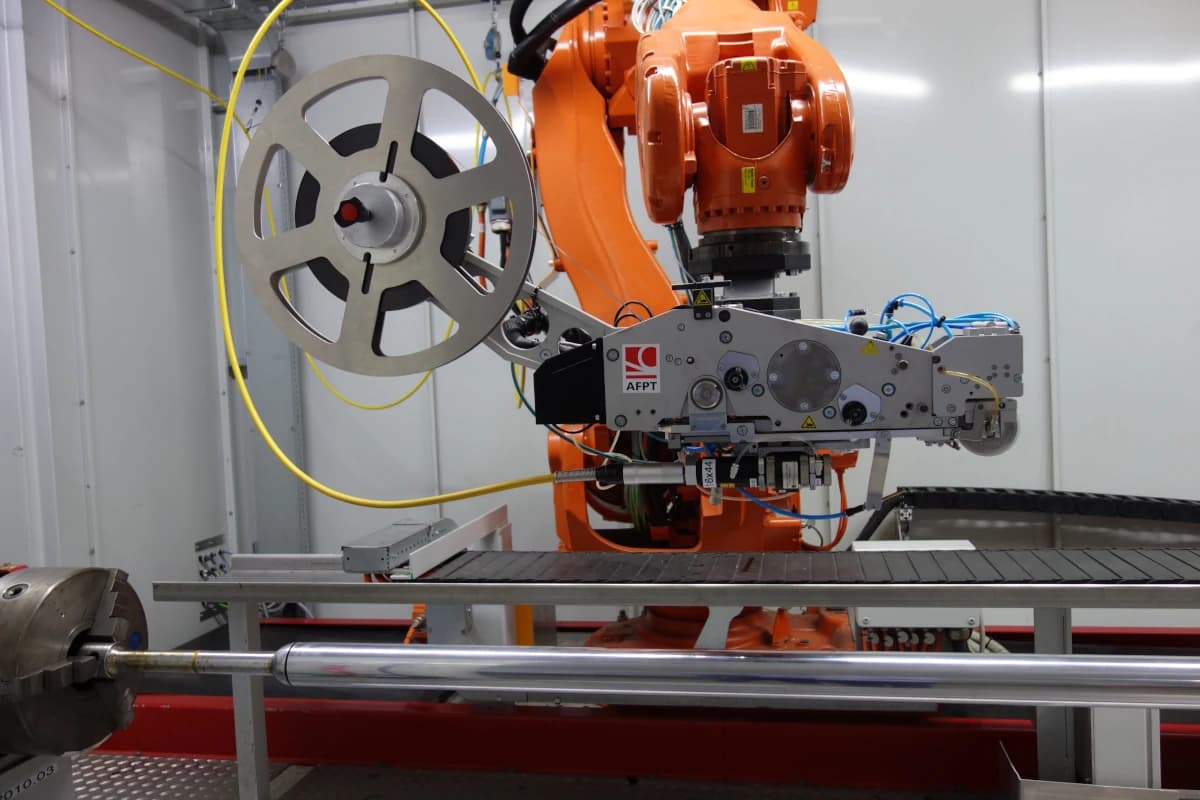
In fiber placement, UD-Tapes are heated (e.g., by laser) and laid onto a mold. This process allows the production of complex geometries with load-aligned fiber orientation, resulting in optimal material utilization. Both flat and curved parts can be produced. Rotationally symmetric components such as drive shafts are now a standard application.
This technology has reached TRL 9 and is used industrially. Various manufacturers offer fiber-placement machines for UD-Tapes. One example is AFPT located in Dörth (Germany), which has produced UD-Tape fiber-placement equipment since 2007 and is now established worldwide:
Other machine manufacturers include:
2. Use as a Reinforcement Element (e.g., in Injection Molding)
UD-Tapes can also serve as local reinforcement in injection-molded parts. They are placed and fixed in the mold before injection. This can be done with individual UD-Tape strips or by using a preform made of layered UD-Tapes (preferrably in load-compliant configurations). The preform is inserted into the injection molding machine and overmolded ("overmolding").
Market Opportunities and Growth Potential for UD-Tapes
The market outlook for UD-Tapes is tied to the growth of thermoplastic composites, considered the fastest-growing segment within fiber-reinforced materials.
Global Market Development
The global composites market reached 13.5 million metric tons in 2024, up approximately 4% over 2023 [10].
UD-Tape Development in Europe
Among thermoplastic long- and continuous-fiber composites, UD-Tapes account for about 10 kt of production volume (2024), making them the smallest subgroup but the only category with a stable or growing trend [12]. Their combination of continuous-fiber structure and thermoplastic matrix enables automated mass-production processes, especially for transport, hydrogen infrastructure, and aerospace applications. Recent technology advances have enabled industrial series production of UD-Tapes and significantly reduced processing costs. This expands their use as an alternative to steel or aluminum.
Market Drivers and Application Sectors
1. Transportation
About 64% of all thermoplastic composites are used in transportation, led by the automotive sector [4]. UD-Tapes enable weight-optimized structural parts with integrated functions via overmolding or insert molding. While passenger car sales remain under pressure (2024: ~10.6 million units, well below 2019 levels) [5], robust commercial vehicle demand (+5.5% vs. 2023) supports the market.
2. Aerospace
The growing adoption of thermoplastic processing, such as laser welding and in situ fiber placement, boosts UD-Tape use in aircraft manufacturing. Benefits include low weight, high impact resistance, and reduced cycle times. New applications are emerging in clips, mounts, and secondary structures.
3. Renewable Energy & Hydrogen
With wind energy and hydrogen infrastructure, new growth segments are emerging. UD-Tapes are ideal for filament-wound high-pressure tanks due to their high strength and low weight. Rotor blades also benefit from thermoplastic matrices through improved reparability and recyclability.
4. Construction & Infrastructure
Thermoplastic UD-Tapes are increasingly used in corrosion-resistant pultruded profiles, cable trays, reinforcement structures, and tanks. Despite a 4% downturn in construction in 2024, civil infrastructure (transport/energy) grew by 7.8%, remaining a key target for fiber-reinforced polymers [6].
Technological Advantages and Challenges
Advantages:
- Automation: UD-Tapes are ideal for laser welding, fiber placement, or tape laying – key for cost-efficient series production.
- Recyclability: The thermoplastic matrix can be remelted and reintegrated into the circular economy.
- Functional Integration: Overmolding allows embedding additional functionality directly into the part.
Challenges:
- Costs & Location Factors: High-energy prices, CO2 levies, and raw-material costs put the European industry under pressure [7]; Chinese overcapacity leads to significant price distortions [8].
- Regulatory Hurdles: New fiber-reinforced systems with thermoplastic matrices often require lengthy approval processes – especially in construction, aerospace, and mobility – extending development cycles.
Market Outlook
Despite these challenges, the outlook remains positive. The Composites Development Index by Composites Germany signals rising expectations, driven by the growing market penetration of high-performance thermoplastic composites [9]. While other material classes stagnate or decline, thermoplastic UD-Tapes offer substantial technological and application-specific growth potential. The combination of lightweight design, fast processability, and sustainability is a clear competitive advantage.
Summary
UD-Tapes represent a forward-looking technology, combining high strength, low weight, and sustainability. As continuous fiber-reinforced thermoplastics, they deliver outstanding mechanical properties with excellent processability. The technology has advanced rapidly and is industrially ready at TRL 9. Their versatility – from automotive to aerospace to renewable energy and hydrogen infrastructure – underscores their potential.
Despite current economic headwinds, the UD-Tape market shows stable to growing trends – a clear indicator of this technology’s promises. Automation capability, recyclability, and easy functional integration position UD-Tapes for a key role in modern industry, contributing to resource efficiency and the circular economy.
Quellen
AVK – Industry Association for Reinforced Plastics e.V. (2023). Composites Market Trends 2022.
Mordor Intelligence (2023). Unidirectional Tape Market – Growth, Trends, COVID-19 Impact, and Forecasts (2023-2028).
Precedence Research (2023). Unidirectional Tapes Market Size, Share, Growth, Trends, and Forecast 2023-2032.
Grand View Research (2023). Unidirectional Tape Market Size, Share & Trends Analysis Report.
Composites Germany (2023). Market Development and Trends in the Composites Industry.
Mordor Intelligence (2023). Unidirectional Tape Market – Growth, Trends, COVID-19 Impact, and Forecasts (2023-2028).
Precedence Research (2023). Unidirectional Tapes Market Size, Share, Growth, Trends, and Forecast 2023-2032.
Grand View Research (2023). Unidirectional Tape Market Size, Share & Trends Analysis Report.
AVK – Industry Association for Reinforced Plastics e.V. (2023). Composites Market Trends 2022.
AVK – Industry Association for Reinforced Plastics e.V. (2024). Composites Market Trends 2024.
Composites Europe (2024). European Composites Market Report 2024.
Mordor Intelligence (2024). Unidirectional Tape Market – Growth, Trends, and Forecasts (2024-2029).
AVK – Industry Association for Reinforced Plastics e.V. (2023). Composites Market Trends 2022.
Mordor Intelligence (2023). Unidirectional Tape Market – Growth, Trends, COVID-19 Impact, and Forecasts (2023-2028).
Precedence Research (2023). Unidirectional Tapes Market Size, Share, Growth, Trends, and Forecast 2023-2032.
Grand View Research (2023). Unidirectional Tape Market Size, Share & Trends Analysis Report.
Composites Germany (2023). Market Development and Trends in the Composites Industry.
Mordor Intelligence (2023). Unidirectional Tape Market – Growth, Trends, COVID-19 Impact, and Forecasts (2023-2028).
Precedence Research (2023). Unidirectional Tapes Market Size, Share, Growth, Trends, and Forecast 2023-2032.
Grand View Research (2023). Unidirectional Tape Market Size, Share & Trends Analysis Report.
AVK – Industry Association for Reinforced Plastics e.V. (2023). Composites Market Trends 2022.
AVK – Industry Association for Reinforced Plastics e.V. (2024). Composites Market Trends 2024.
Composites Europe (2024). European Composites Market Report 2024.
Mordor Intelligence (2024). Unidirectional Tape Market – Growth, Trends, and Forecasts (2024-2029).