Pipelines für erneuerbare Energie
Warum Wasserstoffleitungen aus faserverstärkten Kunststoffen ein Schlüssel zur Energiewende sind

Die zukünftige Energieversorgung basiert zunehmend auf erneuerbaren Quellen. Um diese Energie effektiv nutzbar zu machen, bedarf es neuer Konzepte für Transport und Speicherung – insbesondere in Form von Wasserstoff. Hierbei rücken Werkstoffe wie thermoplastische Faser-Kunststoff-Verbunde (FTV) in den Fokus der Forschung und Entwicklung.
Wasserstoff als Schlüsselelement der Energiewende
Wasserstoff ist ein vielversprechender, speicherbarer und CO₂-freier Energieträger, der durch Elektrolyse von Wasser mithilfe von erneuerbaren Energien gewonnen werden kann. Er lässt sich in vielfältigen Sektoren einsetzen – etwa als Brennstoff, als Speichermedium oder als Grundstoff in chemischen Prozessen.
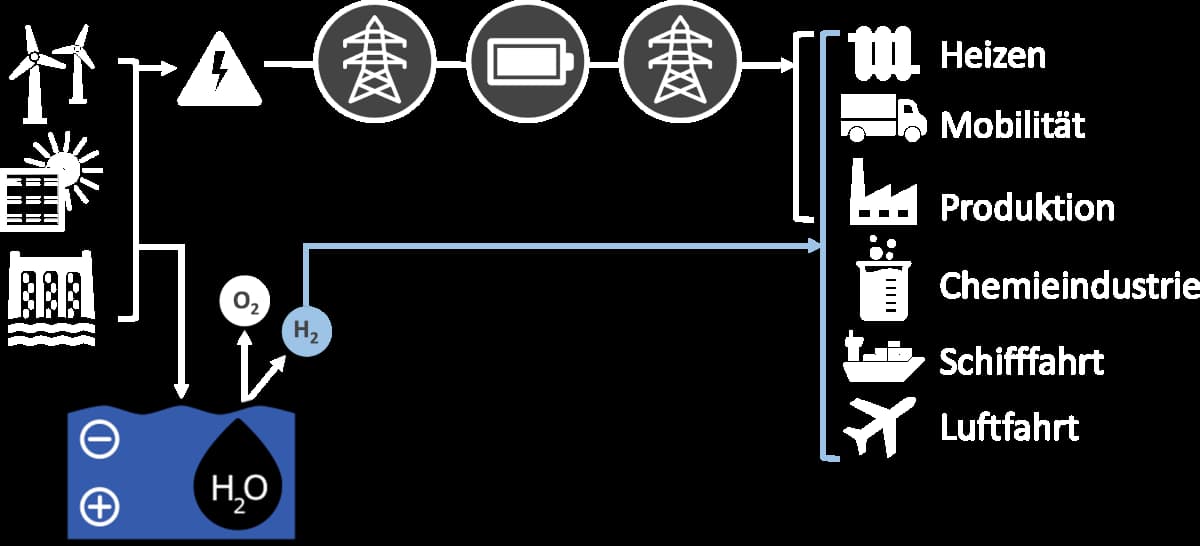
Da Erzeugungs- und Verbrauchsorte oft räumlich getrennt sind, entsteht ein erheblicher Bedarf an einer dedizierten Transport- und Speicherinfrastruktur. Der Transport über Rohrleitungen gilt dabei als effizienteste Lösung [1]. Vor allem unter Druck gespeicherter, gasförmiger Wasserstoff kann in solchen Leitungen nicht nur bewegt, sondern gleichzeitig gepuffert werden.
Herausforderungen konventioneller Rohrsysteme
Aktuell dominieren Stahlrohre den Wasserstofftransport. Doch diese stoßen an Grenzen: Wasserstoff kann die Mikrostruktur von Metallen verändern und zur sogenannten Wasserstoffversprödung führen. Dies beeinträchtigt insbesondere Schweißverbindungen, erhöht das Risiko von Rissen und verkürzt die Lebensdauer der Leitung [2][3].
Die Hauptherausforderungen bei Stahlrohren für den Wasserstofftransport sind:
- Wasserstoffversprödung und damit verbundene Sicherheitsrisiken
- Begrenzte Druckfestigkeit bei höheren Betriebsdrücken
- Komplexe Qualitätssicherung der Schweißverbindungen
- Anfälligkeit gegenüber Druckschwankungen
- Hohe Materialkosten für spezielle wasserstofftaugliche Stähle
- Eingeschränkte Flexibilität bei der Verlegung
Ein weiteres Problem liegt im hohen Gewicht, der eingeschränkten Verlegbarkeit in unzugänglichem Gelände sowie der Notwendigkeit kostspieliger Schutzmaßnahmen gegen Korrosion.
Potenzial thermoplastischer Faserverbundwerkstoffe
Thermoplastische Faser-Kunststoff-Verbunde (FTV) bieten eine alternative Lösung. Diese Materialien kombinieren eine thermoplastische Matrix mit Verstärkungsfasern (z. B. Glas oder Kohlenstoff) und zeigen unter Wasserstoffeinfluss keine Anzeichen von Versprödung.
Wesentliche Vorteile:
- Keine Wasserstoffversprödung
- Hohes Festigkeits-Gewichts-Verhältnis
- Geringe Wasserstoffdiffusion
- Korrosionsfreiheit
- Thermoplastische Rezyklierbarkeit
- Formflexibilität durch Wickeltechnologien
Die mechanischen Eigenschaften erlauben den Betrieb bei hohen Drücken und eignen sich sowohl für Transportleitungen als auch für Speicherlösungen.
Anforderungen an die zukünftige Infrastruktur
Die Energiewende und insbesondere die europäische Wasserstoffstrategie erfordern ein umfassendes Leitungsnetz. Allein in Europa wird mit einem Bedarf von bis zu 53.000 km an Wasserstoffleitungen gerechnet – ein Großteil davon muss noch gebaut werden [4].
Gleichzeitig steigen die Anforderungen an Betriebssicherheit, Druckfestigkeit, Langlebigkeit und Nachhaltigkeit. Diese Anforderungen lassen sich mit neuartigen Materialien wie FTV gezielt adressieren.
Wirtschaftliche und ökologische Überlegungen
FTV-Rohrsysteme bieten nicht nur technische Vorteile, sondern sind auch wirtschaftlich konkurrenzfähig. Die Vorteile im Detail:
- Geringerer Wartungsbedarf
- Längere Lebensdauer
- Geringeres Gewicht = einfachere Installation
- Weniger Maschinen und Schweißverbindungen
- Möglichkeit der industriellen Fertigung als Spule, ideal für modulare Verlegung
Erste Studien zur Total Cost of Ownership (TCO) zeigen, dass sich die Investition durch geringere Betriebskosten und höhere Systemverfügbarkeit auszahlt [5].
Technologischer Entwicklungsstand
Obwohl der Einsatz von Faser-Kunststoff-Verbunden im Bereich der Druckbehältertechnik bereits weit verbreitet ist, hat sich dies im Rohrleitungsbereich bisher nicht durchgesetzt. Der Hauptgrund hierfür ist das Fehlen eines standardisierten Vorgehens und der notwendigen Zulassungen für den Einsatz in der Praxis. Konkret bedeutet dies:
- Fehlende Normen und Standards für die Herstellung und Prüfung
- Keine einheitlichen Zulassungsverfahren für den Einsatz
- Unklare regulatorische Rahmenbedingungen
- Mangelnde Erfahrungswerte für die Langzeitbewährung
Fazit
Angesichts steigender Anforderungen an die Wasserstoffinfrastruktur und der Limitierungen konventioneller Materialien bieten faserverstärkte Thermoplaste eine zukunftsfähige Alternative. Ihre herausragenden Werkstoffeigenschaften, gekoppelt mit nachhaltiger Verarbeitbarkeit, machen sie zu einem potenziellen Schlüsselmaterial der Energiewende – besonders im Bereich des unter Druck stehenden Wasserstofftransports. Die industrielle Umsetzung steht zwar noch am Anfang, doch das Potenzial ist enorm – technisch, ökologisch und wirtschaftlich.
Quellen
IEA (2019). The Future of Hydrogen. Report für G20. Japan.
Birnbaum, H. K. (1978). Hydrogen Related Failure Mechanisms in Metals. Illinois University.
Pohl, M. (2019). Hydrogen-Induced Delayed Cracking. Pract. Metallogr., Bd. 56, Nr. 9.
European Hydrogen Backbone (2020). Gas for Climate.
Mack, J., Mitschang, P., & Schledjewski, R. (2011). Cost comparison of different thermoplastic and thermoset filament winding processes.
IEA (2019). The Future of Hydrogen. Report für G20. Japan.
Birnbaum, H. K. (1978). Hydrogen Related Failure Mechanisms in Metals. Illinois University.
Pohl, M. (2019). Hydrogen-Induced Delayed Cracking. Pract. Metallogr., Bd. 56, Nr. 9.
European Hydrogen Backbone (2020). Gas for Climate.
Mack, J., Mitschang, P., & Schledjewski, R. (2011). Cost comparison of different thermoplastic and thermoset filament winding processes.